A dermatologist looked at my $340 skincare routine and asked one question I couldn't answer
I'd spent eleven years buying the best creams I could find. Then someone asked me which layer of my skin they were actually reaching — and I realised I'd never once thought about it.
I want to start with the least flattering fact about me.
At my worst, I was spending around $340 a month on my face. A vitamin C serum in the morning. A peptide thing that came in a glass pipette. Eye cream that cost more per gram than saffron. A night cream I genuinely liked. Retinol on Tuesdays and Fridays, when my skin could take it.
Eleven years of that. And here's the part I'd never admitted out loud: I couldn't point to a single thing that had actually changed.
My skin felt lovely for about forty minutes after I applied anything. Then it went back to being the skin of a woman in her late fifties who'd spent thirty summers in the garden without thinking twice about it.
The photograph I couldn't stop looking at
It was my son's wedding. October. Someone took a photograph of me holding a glass, mid-laugh, in that hard early-afternoon light that doesn't forgive anything.
I didn't look old. That wasn't it. I looked tired. Flat. Like someone who hadn't slept properly in a decade, which wasn't true. The skin on my hands, gripping the glass, looked like tissue paper that had been folded and smoothed out again.
I went home and stood in front of the bathroom cabinet and counted eleven products. Then I worked out what I'd spent on them since 2015.
It came to more than my first car.
What I'd already tried, honestly
Nothing was a scam, exactly. Everything worked a little, briefly, at the surface. Nothing held.
Then someone asked me which layer
I ended up sitting next to a dermatologist at a dinner. Not my appointment, not her patient — just the person to my left, being polite about my complaining.
I listed the routine. She let me finish. Then she asked:
I had no answer. In eleven years and several thousand dollars, I had never once thought about it as a question of depth.
So she explained it, on a napkin, in about ninety seconds.
Why a cream stops where it stops
Your skin's outer layer exists to keep things out. That's its entire job. It is, in her words, a very good wall.
Creams work on that wall — they soften it, they hold water in it, and they make it look and feel better. Genuinely. That's not nothing.
But the things I actually wanted back — firmness, bounce, the ability to spend an afternoon outside without paying for it — are built underneath that wall. And a wall that good doesn't let much through from the outside.
Which is why my results had always plateaued at "feels nice." I was maintaining a wall and expecting the house to change.
Why salmon are pink
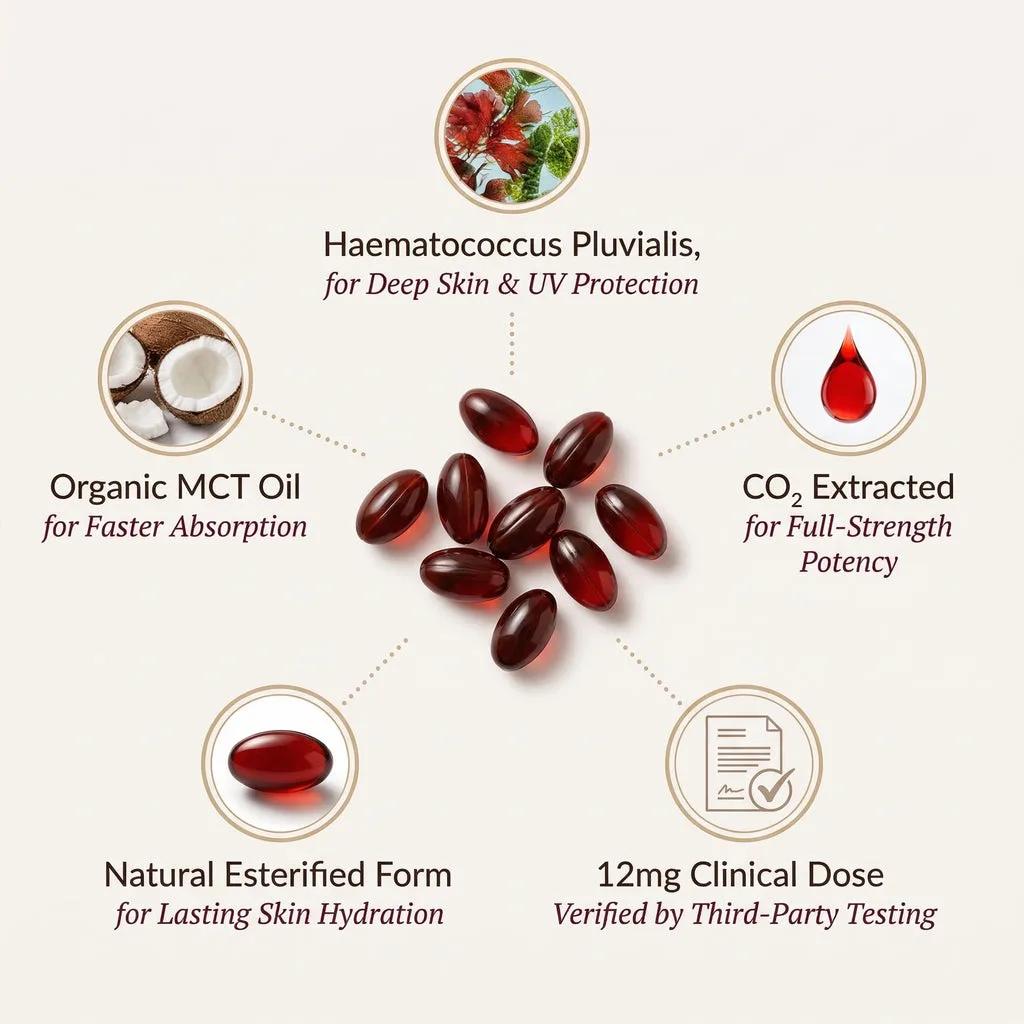
The thing she mentioned, almost in passing, was astaxanthin.
It's the red pigment that makes wild salmon pink, and flamingos pink, and lobster shells go red in the pan. It's produced by a freshwater microalgae called Haematococcus pluvialis, which makes it as a shield when it's stressed by bright light. Everything up the food chain gets its colour by eating it.
Two things make it unusual. It's fat-soluble, so it travels well in the body and reaches tissue that water-soluble antioxidants don't. And it sits inside the cell membrane rather than at the edge of it, which is why researchers keep coming back to it for the tissues that take the most daily wear — skin, eyes, joints.
I went home and read for three weeks. Then I went and bought a bottle.
And that's where it went wrong for eight months
Nothing happened. Nothing at all, for eight months, across three different brands.
I nearly wrote the whole thing off. Then I went back through the studies I'd read and did something obvious: I compared the dose in the research to the dose in my cupboard.
The research kept using 12 mg. Every bottle I'd bought was 4 mg.
Then I found the second problem, and it was worse. Astaxanthin is fat-soluble — it needs an oil to be absorbed. Two of my three bottles were dry powder in a capsule. I had been swallowing an ingredient my body had almost no way of taking up.
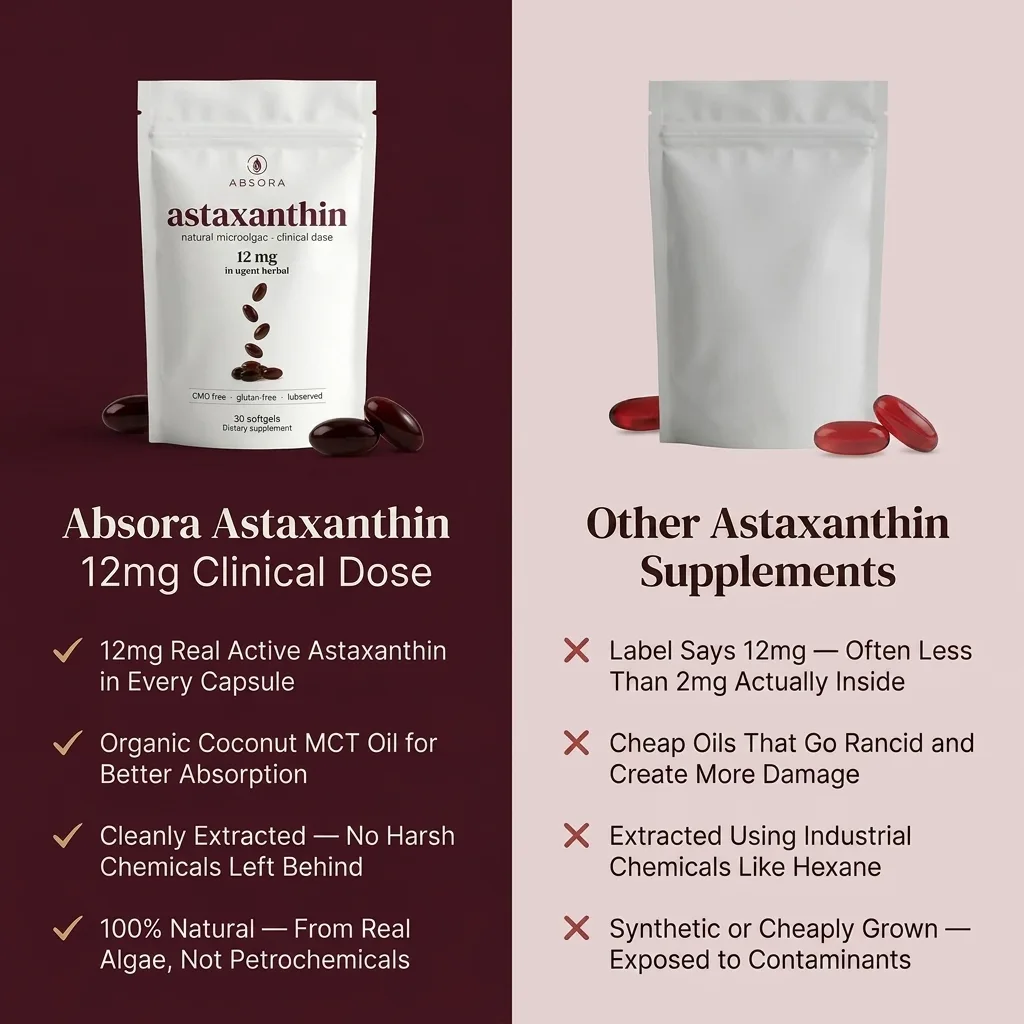
Why is the market like this? Because natural astaxanthin is genuinely expensive to grow and extract. 4 mg of it in a dry capsule is what you make when you're designing to a shelf price. It is not what you make when you're designing to the research.
So we made the one I'd been looking for
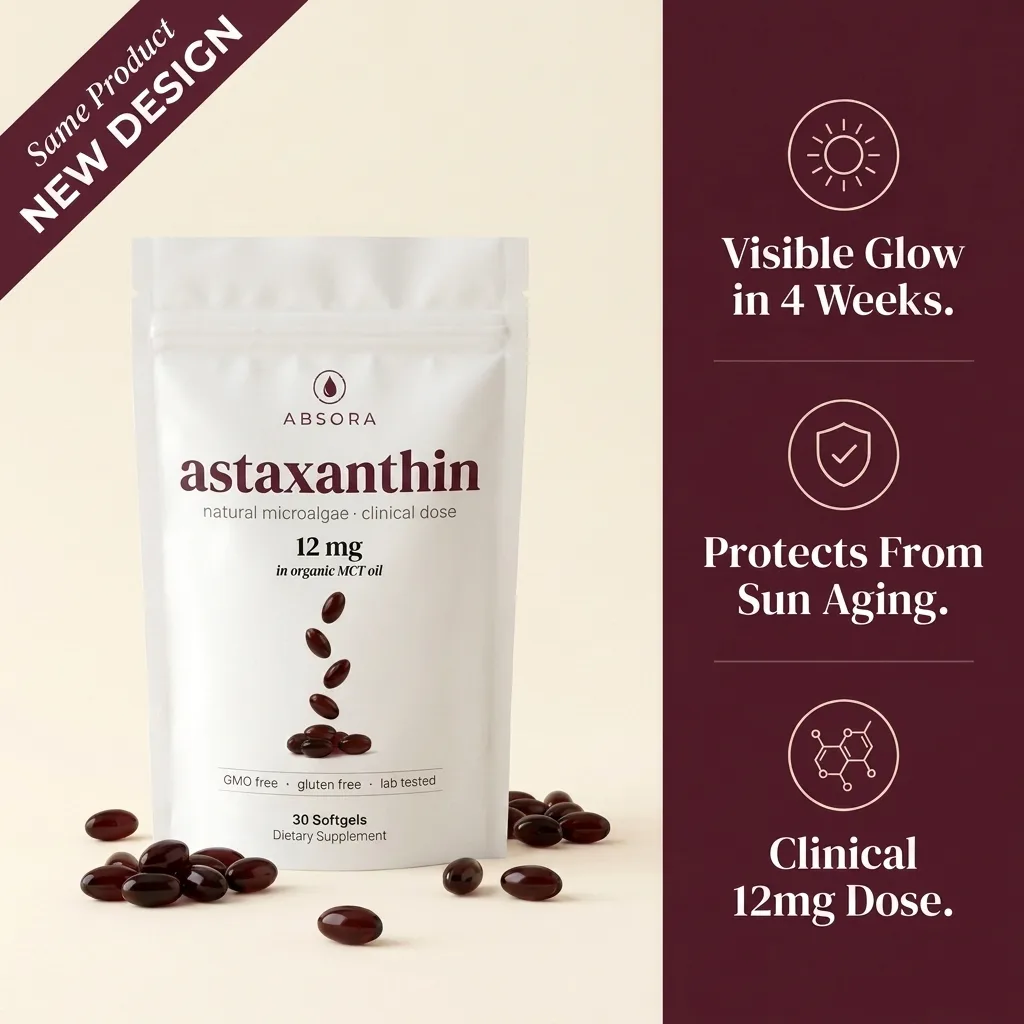
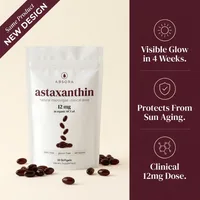
It's called Absora Astaxanthin 12 mg, and there is nothing clever about it. That's rather the point. It's the version I couldn't buy:




What actually happened, on my face
I'm going to be careful here, because this is where these articles usually start lying.
Weeks one to three: nothing. Truly nothing. If you want something you can feel on day two, this is the wrong product and I'd rather tell you now.
Around week five, my skin stopped feeling tight after a shower. Small thing. I only noticed because it had been true for years.
Week eight or nine, my sister asked what I'd changed. She's not a person who says nice things to be kind, so I took it seriously.
By twelve weeks, the thing I'd wanted from that wedding photograph: I stopped looking tired. The backs of my hands stopped being the first thing I noticed about them. And — I did not expect this at all — I could read a whole evening without my eyes giving out at nine o'clock.
My routine now is a cleanser, a moisturiser, SPF, and one softgel with lunch. I kept the products that earned it. Seven jars went in the bin.
One softgel a day, and 90 days to decide
The three-pouch supply is the run that matches the research. If your skin looks no different at the end of it, you get your money back — opened pouches included.
Check availability →What it replaced, in money
This was the argument that finished it for me. Not the science — the arithmetic.
Other people, in their own words
Shared with permission. Results vary — these are individual experiences, not a promise.
{{ t.quote }}
Who I'd tell not to bother
If you want a change you can see next week, don't buy it. You'll be disappointed at day ten and you'll stop at day fifteen, and you'll have wasted the money for a reason I could have warned you about.
If you're on blood thinners or hormone medication, pregnant or nursing, speak to your doctor first. It's a short label — take it to the appointment.
And if you're hoping to stop wearing sunscreen: no. This works underneath the skin and SPF works on top of it. Keep doing both.
What happens if you order
P.S. — The photograph from the wedding is still on my phone. I keep it there deliberately. There's one from my granddaughter's christening in June that I like considerably better, and the only thing that changed between them was one softgel with lunch.
P.P.S. — If you've already tried astaxanthin and thought it did nothing, go and look at the bottle. If it says 4 mg, or if it's a dry powder capsule, that's very likely the whole explanation. It was mine.
Comments
{{ commentCount }} comments{{ c.text }}
This article is sponsored content published by Absora. It reflects one person's experience and is not medical advice.
These statements have not been evaluated by the Food and Drug Administration. This product is not intended to diagnose, treat, cure or prevent any disease.
Individual results vary. Astaxanthin is not a sunscreen and is not a substitute for SPF. Consult your healthcare provider before starting any supplement, especially if you are pregnant, nursing, taking medication or have a medical condition.