{{ rev.body }}
7 Reasons Statin Side Effects Don't Mean You're Out Of Options — And Why Men And Women Who Learn This Add Citrus Bergamot
Muscle symptoms are the most common reason people stop taking a statin. Most of them never tell their doctor. Here's what the research actually says about the options you still have — and where a researched botanical fits alongside them.
Nothing here is medical advice, and nothing here is a reason to change or stop a prescribed medicine.
Review slot — the strongest shape names a dated before-and-after panel.
Review slot — second-strongest shape names a doctor's reaction.
Most People Who Stop Never Say Why
Muscle symptoms are the single most commonly reported reason people discontinue a statin. Cost and perceived lack of effect are a long way behind.
The part that matters more: a large share of that stopping happens silently. Roughly half of statin prescriptions are abandoned within the first year, and a meaningful proportion are never filled at all. In one study, around a third of people who stopped said they never communicated that decision to the person who prescribed it.
If you've been putting up with something and not mentioning it, you are not the exception. You're the pattern.
One Bad Experience Isn't The Whole Category
The most expensive belief in this whole area is that there are two options: put up with it, or give up on the cholesterol goal entirely.
Statin intolerance is frequently specific to a particular agent, dose or schedule rather than being true of the entire class. In rechallenge studies, the large majority of people previously labelled statin-intolerant went on to tolerate a statin — often a different one, at a different dose, or on a different schedule.
There's a physical reason for that. Lipophilic statins penetrate muscle tissue more readily than hydrophilic ones, which is one of several factors that can make one agent feel very different from another.
This is the single most useful thing to know before you make any decision quietly and on your own.
There's A Named Pathway From The Tablet To Your Legs
Being told it's probably not the medication, when your body says otherwise, is not a satisfying answer. Here's the biochemistry.
Statins work by blocking HMG-CoA reductase. That enzyme sits at the top of the mevalonate pathway. Cholesterol is produced down that pathway — which is the intended effect — but so are other compounds, including CoQ10, which mitochondria use to produce energy.
Block the top of a chain and you reduce what comes off the whole chain, not only the target.
Whether CoQ10 depletion specifically causes muscle symptoms remains debated, and supplementation trials aimed at it have produced mixed results. So this isn't a settled explanation. But it is a real, described mechanism, and knowing it exists changes the conversation you can have about it.
You're Making Three Decisions, Not One
Whether to take your cholesterol seriously is one decision.
Which medication, at which dose, on which schedule, is a second — and it belongs to you and your prescriber together, not to a website.
Whether anything else is worth having alongside it, the way diet and exercise sit alongside it, is a third.
Most people collapse all three into one and then feel trapped by the result. Separating them is what reopens the options: dose, agent, schedule, other contributors, and additional evidence-backed support categories.
Most Of Your Cholesterol Was Never On Your Plate
The large majority of cholesterol in your blood isn't eaten. Your body makes it, mostly in your liver.
Harvard puts internal production at roughly 80%, against about 20% from food — and notes that the body compensates. Eat less cholesterol and the liver simply produces more.
This is why cutting the obvious foods often moves the number far less than people expect. It isn't a failure of effort. It's a mismatch between where the effort went and where the cholesterol is made.
Diet still matters. It just isn't the main tap.
The Liver Has A Mechanism For Taking LDL Back Out
If most of it is made in the liver, that's where the interesting question sits.
The liver expresses LDL receptors — structures whose job is to pull LDL back out of the bloodstream. More receptor activity means more clearance.
Citrus bergamot, a fruit grown in Calabria, has been studied in this area. Its polyphenol fraction contains two compounds, brutieridin and melitidin. In cell studies, both have been shown to increase LDL receptor expression.
Two things to be clear about, because they matter.
That receptor finding is preclinical cell work, not a demonstrated clinical outcome in people. And the human evidence on bergamot is limited: a modest number of trials, using preparations that differ substantially from one another, with review authors calling for higher-quality research. The US National Center for Complementary and Integrative Health describes the evidence as limited and the pooled findings as uncertain.
A plausible mechanism and a real research base. Not a promise, and not a substitute for anything.
What Absora Is, And What It Isn't
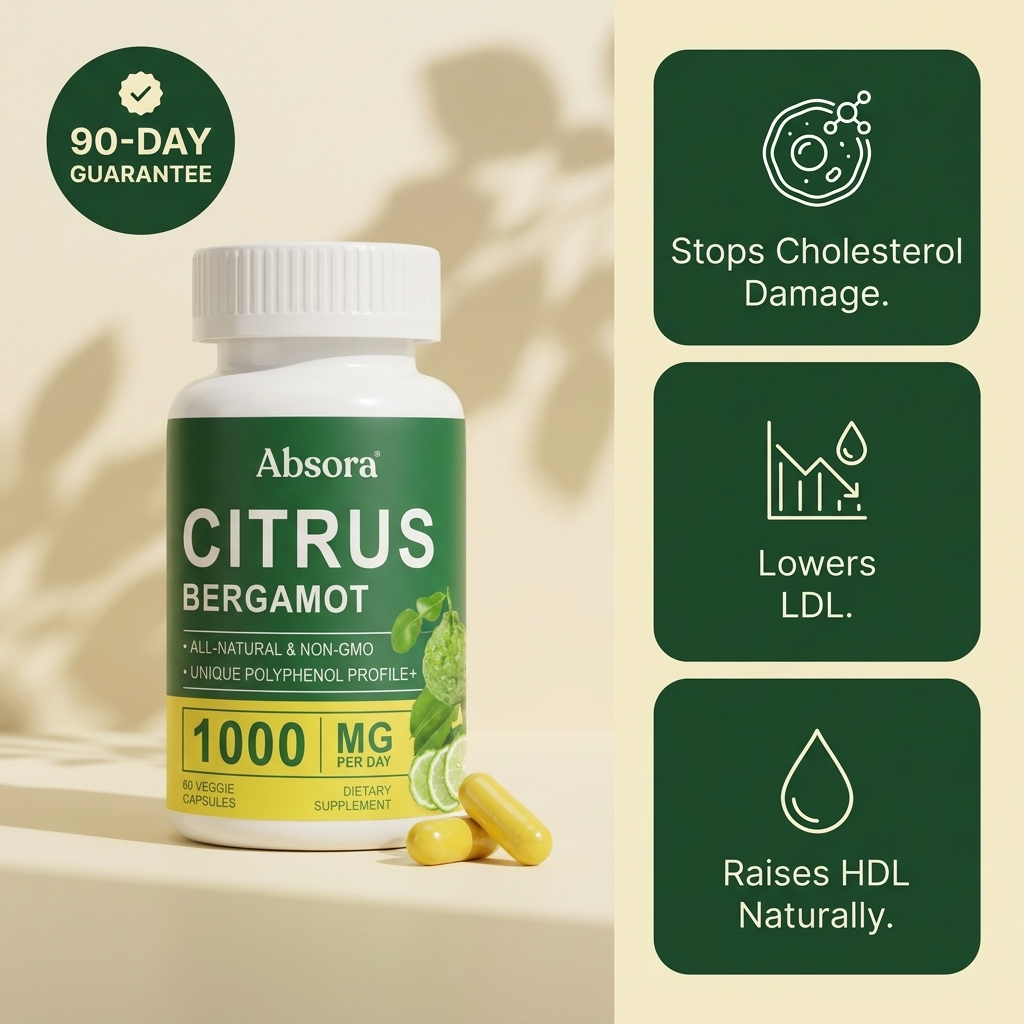
Absora Citrus Bergamot is 1,000 mg of bergamot fruit extract per two-capsule serving. 60 vegetable capsules. 30 servings. One bottle a month.
One ingredient, one job, no proprietary blend.
What it's for: sitting alongside the rest of a plan. The same shelf as the walking and the diet.
What it isn't: a replacement for a statin, a reason to change your dose, or a reason to skip one. If you're taking a prescribed medicine, that conversation is with your doctor.
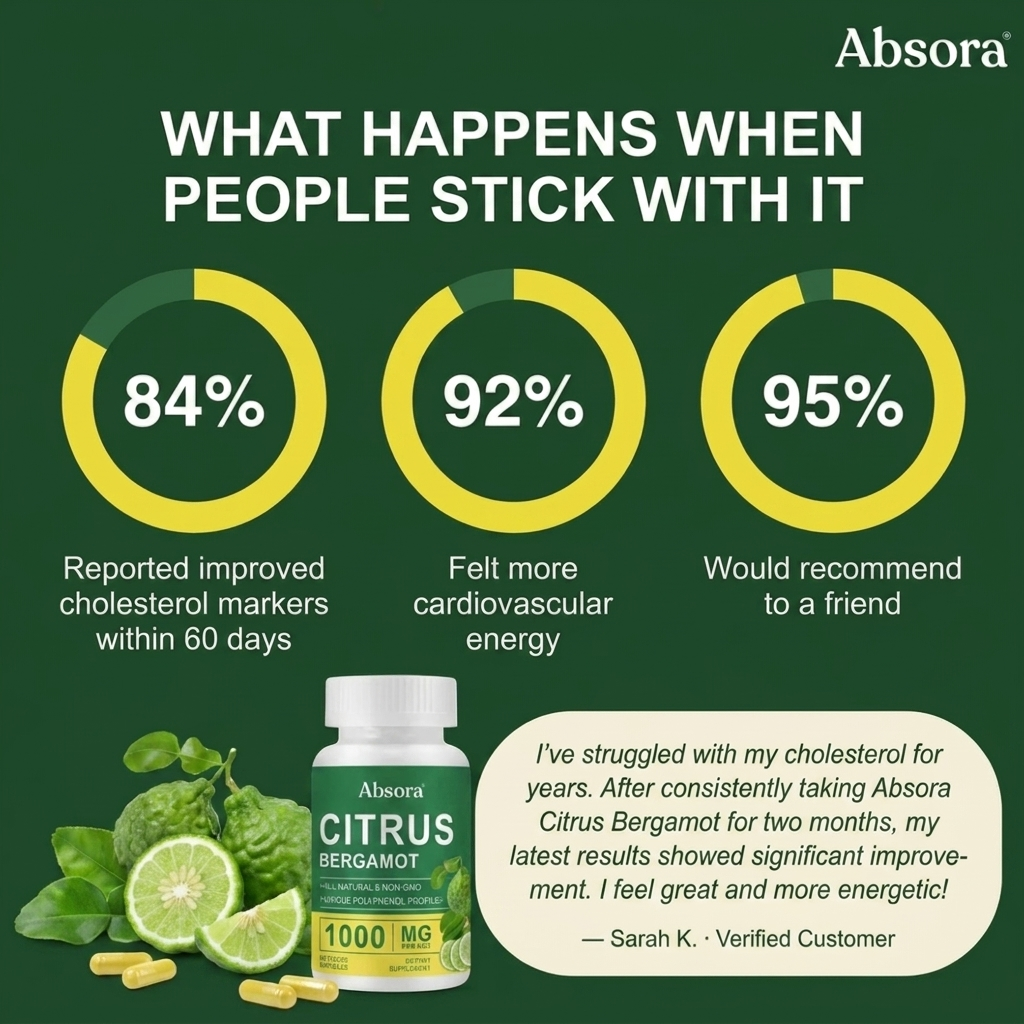
One more thing worth saying. Most people change several things at once — dose, routine, diet, a supplement — and then get one blood test. A panel measures the whole picture, not which change earned it. Anyone claiming a single bottle explains their result is guessing, and we're not going to.
Bergamot Polyphenol Support, Alongside What You're Already Doing
1,000 mg bergamot fruit extract per two-capsule serving. 60 vegetable capsules. 30 servings.
One ingredient, one job, no proprietary blend. 1,000 mg bergamot fruit extract per serving in vegetable capsules. Built to sit alongside a plan rather than replace one.
Pending label. Sourcing, extraction, standardisation and testing claims are currently unverified and will be published from the finished label.
Human trials on citrus bergamot preparations report possible effects on lipid markers, from a limited evidence base using preparations that differ from each other. Preclinical work identifies brutieridin and melitidin and their effect on LDL receptor expression in cell models. We haven't matched our preparation to any published trial, and we'll say so until we can. Certifications pending documentation.
Two capsules daily with food. One bottle is 30 days. Pending label confirmation.
Bergamot may interact with some medications. Speak to your doctor or pharmacist before adding it. Nothing on this page is a reason to change, reduce or stop a prescribed medicine.
Customer reviews
Review structure only. Real, permissioned reviews replace these at launch — the ones worth featuring name a dated before-and-after panel and, where possible, the doctor's reaction.